Your weekly dose of Apple news, iOS guides & more → Subscribe FREE

Apple Private Cloud Compute Explained: How Apple Makes AI More Private
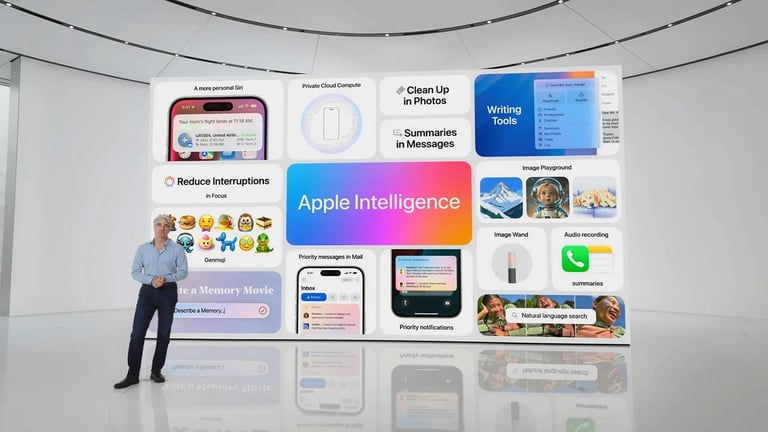
Apple Intelligence uses Private Cloud Compute to bring powerful AI features to your devices while keeping privacy at the center. Here’s how Apple’s secure AI cloud works
APPLE INTELLIGENCE
6/17/202612 min read
If you've heard the term Private Cloud Compute and wondered what it means for your iPhone, you're in the right place. In this article, I'll break it all down for you.
What Is Private Cloud Compute?
Private Cloud Compute (PCC) is Apple's dedicated cloud infrastructure for private AI processing. Introduced in June 2024 at WWDC24 alongside the first version of Apple Intelligence, PCC solves one of the hardest problems in AI: how do you run powerful AI models in the cloud without your personal data ever being exposed. Not even to Apple?
Most AI services work like this: your request goes to a server, the server processes it, and somewhere along the way your data gets logged, stored, or used to train models. Apple's PCC is architecturally designed to make that impossible. Not just promised — technically impossible by design.
Apple's own definition:
"Private Cloud Compute extends the industry-leading security and privacy of Apple devices into the cloud, making sure that personal user data sent to PCC isn't accessible to anyone other than the user — not even to Apple. We believe Private Cloud Compute is the most advanced security architecture ever deployed for cloud AI compute at scale." — Apple Security Engineering and Architecture (SEAR), June 2024
Timeline. When Was It Introduced?
June 2024
Private Cloud Compute (PCC) first introduced at WWDC 2024 alongside Apple Intelligence (iOS 18)
October 2024
PCC goes live for users with iOS 18.1 beta; Virtual Research Environment released to security researchers
October 2024
Apple Security Bounty expanded — up to $1M for critical PCC vulnerabilities
May 2026
Academic paper published analyzing PCC's privacy architecture (arXiv:2605.24239
June 8, 2026
Apple expands PCC beyond its own data centers — now runs on Google Cloud with NVIDIA GPUs (WWDC 2026
June 2026
Third-generation Apple Foundation Models (AFM 3) announced, with AFM 3 Cloud Pro running on PCC via Google Cloud
Fall 2026
Full PCC on Google Cloud operational; iOS 27 / macOS Golden Gate general release.
Who Uses Private Cloud Compute?
PCC is used in three distinct ways:
1. End Users. Via Apple Intelligence
Every time Apple Intelligence offloads a task that's too complex for your device's on-device model, it goes to PCC. This is invisible to users. It happens automatically and silently. Examples:
Complex Siri AI reasoning and multi-step tasks
Agentic tool-use across apps (iOS 27)
Advanced image generation (Image Playground, ADM 3 Cloud Image)
Siri's broad world knowledge queries
Writing Tools for complex generation
2. Small Developers. Free PCC API Tier (New in 2026)
At WWDC 2026, Apple announced that developers enrolled in the App Store Small Business Program with fewer than 2 million first-time App Store downloads can access Apple Foundation Models running on PCC at zero cloud API cost. This includes AFM 3 Cloud (the server-side workhorse model). This is live in the developer beta now, shipping to production with iOS 27 in fall 2026.
3. Security Researchers. Virtual Research Environment (VRE)
Apple offers qualified security researchers live access to PCC nodes in research mode, a downloadable Virtual Research Environment (VRE) to simulate a PCC node on a Mac with Apple silicon, and bounties of up to $1 million for findings.
How PCC Works. The Full Architecture
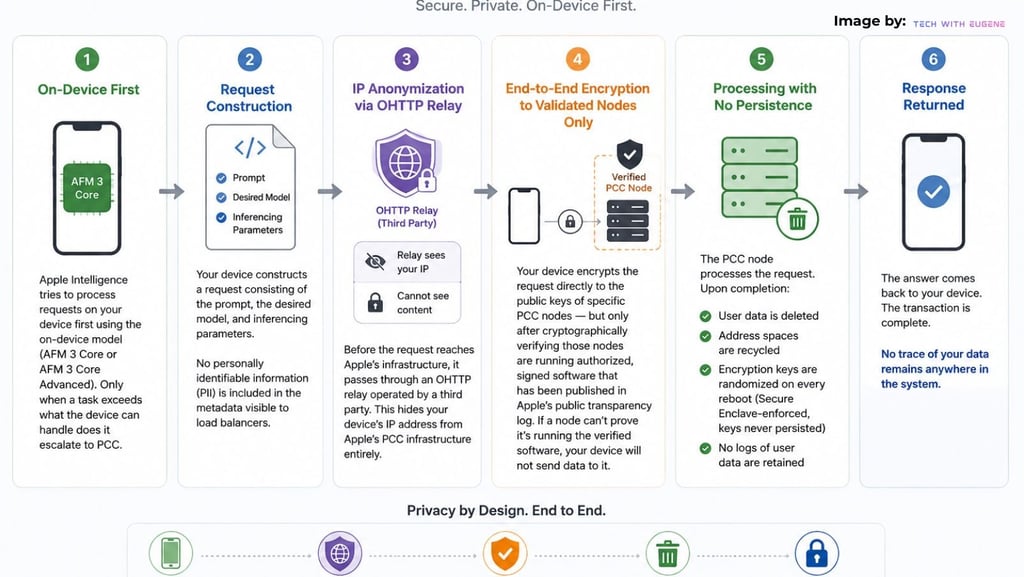
Step 1: On-Device First
Apple Intelligence always tries to process requests on your device first using the on-device model (AFM 3 Core or AFM 3 Core Advanced). Only when a task exceeds what the device can handle does it escalate to PCC.
Step 2: Request Construction
Your device constructs a request consisting of:
The prompt
The desired model
Inferencing parameters
No personally identifiable information (PII) is included in the metadata visible to load balancers.
Step 3: IP Anonymization via OHTTP Relay
Before the request reaches Apple's infrastructure, it passes through an Oblivious HTTP (OHTTP) relay operated by a third party. This hides your device's IP address from Apple's PCC infrastructure entirely. The relay can see your IP but cannot see the content of your request. Apple's servers receive the request but cannot see where it came from.
Step 4: End-to-End Encryption to Validated Nodes Only
Your device encrypts the request directly to the public keys of specific PCC nodes / But only after cryptographically verifying those nodes are running authorized, signed software that has been published in Apple's public transparency log. If a node can't prove it's running the verified software, your device will not send data to it.
Step 5: Processing with No Persistence
The PCC node processes the request. Upon completion:
User data is deleted
Address spaces are recycled
The data volume's encryption keys are randomized on every reboot (Secure Enclave-enforced, keys never persisted)
No logs of user data are retained
Step 6: Response Returned
The answer comes back to your device. The transaction is complete. No trace of your data remains anywhere in the system.
The 2026 Expansion Private Cloud Compute (PCC) Now Runs on Google Cloud
This is the biggest PCC news of 2026 and the most misunderstood story from WWDC.
What happened:
Apple announced on June 8, 2026 at WWDC26, that PCC is expanding beyond Apple's own data centers for the first time. The most powerful model — AFM 3 Cloud Pro — now runs on NVIDIA Blackwell GPUs hosted in Google Cloud, using Google's Titan security chip and Intel CPUs with Trust Domain Extensions (TDX).
Why this happened:
AFM 3 Cloud Pro requires GPU compute that Apple's Apple silicon server infrastructure cannot economically scale to alone. Google Cloud's NVIDIA Blackwell GPUs provide the necessary horsepower.
The privacy question everyone is asking:
Does this mean Google can see your data? No. and here's why.
Apple maintains complete control over PCC software regardless of where it runs. Apple devices only trust PCC nodes that have been cryptographically approved by Apple. Even in Google's data center. The same five PCC requirements (stateless, enforceable, no privileged access, non-targetable, verifiable transparency) apply in full. Apple and Google co-built a layered security architecture that goes beyond standard confidential computing, including:
A cryptographically verifiable, append-only ledger of all Google Cloud hardware in the PCC fleet
Multi-vendor root of trust (NVIDIA confidential computing + Google Titan chip + Intel TDX)
Same architectural patterns as Apple silicon PCC: isolated per-request processes, short-lived inference software, attested key isolation
All binaries running on PCC in Google Cloud are published for public inspection. Same as on Apple silicon.
The Google Cloud PCC rollout timeline:
Developer beta: Available now (June 2026)
Full operational capacity: End of summer 2026
General release: Fall 2026 with iOS 27
Supported Devices
PCC is a server-side technology, so it runs independently of which device you own. However, the on-device model that decides when to call PCC varies by device.
Devices that can use Apple Intelligence (and therefore PCC):
iPhone 15 Pro, iPhone 15 Pro Max
All iPhone 16 models (16, 16 Plus, 16 Pro, 16 Pro Max, 16e)
All iPhone 17 models (17, Air, 17 Pro, 17 Pro Max)
iPad mini (A17 Pro) or later
iPad with M1 or later
Mac with M1 or later
Apple Vision Pro
Devices that unlock the most advanced on-device model (AFM 3 Core Advanced) Which decides when to call AFM 3 Cloud Pro:
iPhone Air
iPhone 17 Pro, iPhone 17 Pro Max
iPad M4 or later with 12GB unified memory
Mac M3 or later with 12GB unified memory
Apple Vision Pro (M5
Note on iPhone 17 standard: The base iPhone 17 has 8GB RAM, not 12GB. It uses AFM 3 Core (3B params) on-device rather than AFM 3 Core Advanced (20B params). It can still use PCC for cloud tasks, but the routing decisions are made by a less capable on-device model.
Availability by Region
United States
Full availability
Most countries
Available when device set to a supported language
European Union (iOS/iPadOS)0
Siri AI (which drives PCC usage) not available at launch due to DMA. Mac, Watch, Vision Pro EU users are unaffected.
China: Not available. Regulatory requirements
Privacy Features. The Full Breakdown
Feature 1: Data Is Never Stored
Why it matters: Every other major AI service stores your queries in some form. For logging, debugging, or model training. PCC is architecturally designed to make storage impossible. The Secure Enclave randomizes the data volume's encryption keys on every reboot and never persists them, meaning even if someone physically seized a PCC server, there would be no recoverable user data on it.
Example: You ask Siri AI to summarize your most sensitive emails. That request is processed and deleted. Apple cannot retrieve it. No one can.
Source: Apple Security Research — Private Cloud Compute
Feature 2: IP Address Anonymization via OHTTP Relay
Why it matters: Even without storing request content, a server that knows your IP address can associate your requests over time. Apple routes all PCC requests through a third-party OHTTP relay that strips your IP address before the request reaches any Apple infrastructure. The relay sees your IP but not the content. Apple sees the content but not your IP. Neither party can link the two.
Example: If you make 100 Siri AI requests in a day. Apple's PCC infrastructure has no way to know those all came from the same person or device.
Source: Apple Security Research — Private Cloud Compute
Feature 3: Target Diffusion — You Can't Be Singled Out
Why it matters: A sophisticated attacker who compromises a PCC node would normally try to wait for a specific target's traffic to arrive. PCC's target diffusion architecture uses RSA Blind Signatures to issue single-use anonymous credentials for each request — making it mathematically impossible to route specific users' requests to specific compromised nodes.
Example: Even if a nation-state actor compromised a PCC node, they could not use that compromise to specifically intercept your requests. They'd have to compromise the entire PCC system. Which is designed to be detectable at scale. Not Even for Apple.
Source: Apple Security Research — Private Cloud Compute
Feature 4: No Admin Backdoor — Not Even for Apple
Why it matters: In every traditional cloud service, administrators can SSH into servers, pull logs, and access user data during troubleshooting. PCC has no remote shell, no interactive debugging mechanism, no general-purpose logging system. SREs at Apple can only access pre-specified, structured, audited metrics — never user data. This is enforced at the OS level.
Example: If Apple's own data centers had a major outage and engineers needed to investigate, they could review operational metrics but could not access any user request data. The architecture makes it impossible, not just policy.
Source: Apple Security Research — Private Cloud Compute
Feature 5: Cryptographic Verification. Your Phone Checks the Server's ID
Why it matters: Your iPhone doesn't just trust Apple's word that a PCC node is running the right software. Before sending any data, your device cryptographically verifies that the node is running an authorized, publicly logged software image. If a node can't prove this, your device simply won't communicate with it.
Example: If Apple secretly tried to push unreviewed software to PCC nodes, user devices would refuse to send requests to those nodes. The system is self-enforcing.
Source: Apple Security Research — Private Cloud Compute
Feature 6: Public Transparency Log. All PCC Code Is Inspectable
Why it matters: Apple publishes measurements of all code running on PCC in a cryptographically tamper-proof, append-only transparency log. Every production build is made available for binary inspection by security researchers within 90 days of deployment. Once a release is signed into the log, it cannot be removed or altered without detection.
Example: Security researchers at any university, independent firm, or government agency can download PCC software images, verify them against the transparency log, and confirm they match what's running in Apple's production environment. This is unprecedented in cloud AI.
Source: Apple Security Research — Private Cloud Compute
Feature 7: Virtual Research Environment (VRE)
Why it matters: Apple released a downloadable VRE — a set of tools and images that simulate a PCC node on a Mac with Apple silicon. Any security researcher can boot PCC software in this virtual environment, modify it, debug it, and investigate its behavior. No other cloud AI service offers anything remotely comparable.
Example: An independent security firm can spin up a simulated PCC environment, send test requests through it, and verify that no data persists after the response is returned — all without needing access to Apple's live production infrastructure.
Source: Apple Security Research — PCC Security Research, SecurityOnline
Feature 8: Apple Security Bounty. Up to $1M for PCC Vulnerabilities
Why it matters: Apple put real financial incentive behind its privacy claims. The bounty program rewards researchers who find actual privacy flaws in PCC — not just theoretical concerns.
Bounty tiers:
$1,000,000 — Arbitrary code execution with arbitrary entitlements on PCC nodes
$250,000 — Ability to execute unattested code
$150,000 — Access to user request data or sensitive information outside the trust boundary
$100,000 — Ability to access user request data from a privileged position
$50,000 — Accidental or unexpected disclosure of data due to deployment or configuration issue
Why it matters: If Apple's privacy claims were exaggerated, the bounty program would have been exploited immediately. The fact that no major PCC privacy breach has been publicly disclosed through the bounty program since 2024 is a meaningful signal.
Hidden PCC Features & Things People Miss
Hidden Feature 1: Your iPhone Is Constantly Auditing PCC Servers
Most people assume PCC privacy is a server-side promise. The reality is your iPhone itself is the enforcer. Before every PCC request, your device checks the public transparency log and refuses to connect to any node not running verified, publicly logged software. Privacy isn't just promised. It's your phone refusing bad actors automatically.
Source: Apple Security Research — Private Cloud Compute
Hidden Feature 2: PCC Was Built on iPhone Security DNA
PCC nodes run a hardened subset of iOS/macOS foundations — not traditional server software. They use the same Secure Enclave, Secure Boot, Code Signing, and sandboxing technologies as your iPhone. Apple essentially built a server OS out of iPhone security primitives. This is why Apple can make security claims about PCC that no traditional cloud provider can make.
Source: Apple Security Research — Private Cloud Compute
Hidden Feature 3: There's No SSH on PCC Nodes. By Design
Remote shell access is the first thing any server administrator would want. PCC nodes deliberately have none. Not disabled & never built in. Code Signing prevents it from being loaded at runtime too. Even if an Apple engineer wanted to access a PCC node via SSH, it is architecturally impossible.
Source: Apple Security Research — Private Cloud Compute
Hidden Feature 4: The Third-Party OHTTP Relay Operator Isn't Apple
The OHTTP relay that strips your IP address before requests reach Apple is operated by a third party — not Apple. This means Apple structurally cannot correlate your IP to your request content, even if it wanted to. The relay operator can see your IP but can't see the encrypted request content. Apple sees the request but not the IP. This is a meaningful architectural separation.
Source: Apple Security Research — Private Cloud Compute
Hidden Feature 5: PCC Servers Are Physically Audited Before Being Switched On
Before any PCC server is allowed into the fleet, Apple performs inventory and high-resolution imaging of all components. When servers arrive at data centers, they undergo extensive revalidation monitored by a third-party observer not affiliated with Apple. Only then is a certificate issued, rooted in each server's Secure Enclave UID. Your iPhone validates this certificate before communicating with that node.
Source: Apple Security Research — Private Cloud Compute
Hidden Feature 6: PCC Source Code Is Partially Open
While PCC is not fully open source, Apple periodically publishes subsets of security-critical PCC source code. Additionally, the sepOS firmware and iBoot bootloader are included in plaintext in PCC images. A first for any Apple platform. Researchers can study the most fundamental security layers of PCC without having to reverse-engineer them.
Source: Apple Security Research — Private Cloud Compute
Hidden Feature 7: The Google Cloud Integration Has a Multi-Vendor Root of Trust
Most confidential computing deployments rely on a single vendor's hardware for trust. PCC on Google Cloud is different: it requires two separate roots of trust from independent vendors for components that could be abused to exfiltrate user data. Compromising one vendor's hardware root is not enough. You'd have to compromise both independently. This makes supply chain attacks dramatically harder.
Source: Apple Security Research — Expanding PCC
Hidden Feature 8: The Free Dev Tier Has a Strict — and Misunderstood — Limit
The free PCC API tier for developers applies to those with fewer than 2 million first-time downloads across all of their apps ever released — not just the app using PCC. A developer who released a popular app 10 years ago and now makes a small new app using PCC might not qualify because of their historical download count. There is currently no paid tier to buy your way in — if you exceed the limit, PCC access simply isn't available to you yet.
Source: Daring Fireball — PCC Severely Limited for Third-Party Developers
Hidden Feature 9: Model Training Never Uses Your Requests
Apple's third-generation Foundation Models were trained on publicly available data, licensed data, open-source data, dedicated studies, and synthetic data. User requests sent to PCC are explicitly excluded from training data. Web publishers can also opt out of their content being used for foundation model training. This is written into the PCC architecture — data processed during inference cannot be retained or repurposed.
If you've made it this far, you now understand PCC better than most people who write about it. I want to tell you, not only what Apple has announced, but why it matters.
Private Cloud Compute isn't a feature. It's a philosophy. The idea that powerful AI and genuine privacy don't have to be a trade-off. Apple is betting their entire AI strategy on that being true.
I think they're right. And I think in a few years, we'll look back at PCC as the moment the industry's standard for cloud AI privacy actually changed.
My thoughts
Follow me on my socials
If you enjoy my content, you can also follow me on my Threads page. I post daily Apple insights, aesthetic photos, iOS tips, and the latest Apple news there. I’d really appreciate your support and would love to see you there. Scan the below QR code to go to my profile.